
WELCOME BONUS 300%
UP TO €2000 + 100
FREE SPINS
UP TO €2000 + 100
FREE SPINS
Home → Blackjack
Blackjack at Gransino: Variants, Rules and Payouts
Infinite Blackjack uses the Six Card Charlie
Infinite Blackjack at Gransino Casino accommodates an unlimited number of players, featuring a minimum bet of 1 EUR and a maximum of 5,000 EUR. This popular variant offers several side bets, including Any Pair, 21+3, Hot 3, and Bust It. Players benefit from a reported RTP of 99.47%, ensuring a competitive return over time.
The Six Card Charlie rule, also known as 'Charlie Seven' in some jurisdictions, is a beneficial rule for players. Under this rule, if a player's hand totals 21 or less with six cards, they automatically win their bet, even if the dealer has a better hand. This provides an additional layer of protection against dealer blackjack or strong dealer hands.
This specific rule offers a practical advantage to high rollers, particularly in situations where a player might otherwise be on the verge of busting. For instance, a hand totaling 17 spread across six cards would become an automatic win, regardless of the dealer's upcard, providing a significant edge in specific scenarios.
Which rule variants does the software show?
Gransino Casino offers several software-based Blackjack variants, including Blackjack Liberal Vegas Strip, which boasts a 99.72% RTP. This variant features a favourable combination of rules such as Standing on Soft 17 (S17), Double After Split (DAS), and Resplit capabilities. The house edge for this particular game is as low as 0.28%.
Another option for discerning players is Blackjack Single Deck, adhering to classic rules with a 3:2 payout for a Blackjack. This version offers a superior RTP of 99.85% and a house advantage of just 0.15%, largely due to the reduced number of decks. The reduced deck count directly contributes to a lower house edge, approximately 0.48% compared to an 8-deck game.
For players seeking to minimise the house edge, Blackjack Liberal Vegas Strip stands out with its player-friendly rules and 3:2 payout. The combination of S17, DAS, and Resplit, along with Late Surrender, results in a standard deviation of 1.15, making it a statistically advantageous choice for those employing optimal strategy.
What Push Means: Stake Returns to You
A 'Push' in Blackjack occurs when the player's hand total matches the dealer's hand total, excluding a Blackjack. In such instances, the player's original bet is returned, meaning neither the player nor the house wins or loses. This outcome is common in Blackjack and prevents a loss for the player's wager.
For example, if both the player and the dealer achieve a hand total of 18, the result is a push. The player's stake is then returned in full, amounting to their initial bet. This scenario is distinct from a win, where the player receives their stake plus winnings, or a loss, where the stake is forfeited.
Understanding pushes is crucial for managing bankrolls, especially for high rollers. While a push does not result in a loss, it also does not yield any profit. This means that while your capital remains intact, you do not benefit from an increased balance on that particular hand.
Insurance vs Even Money on Own Blackjack
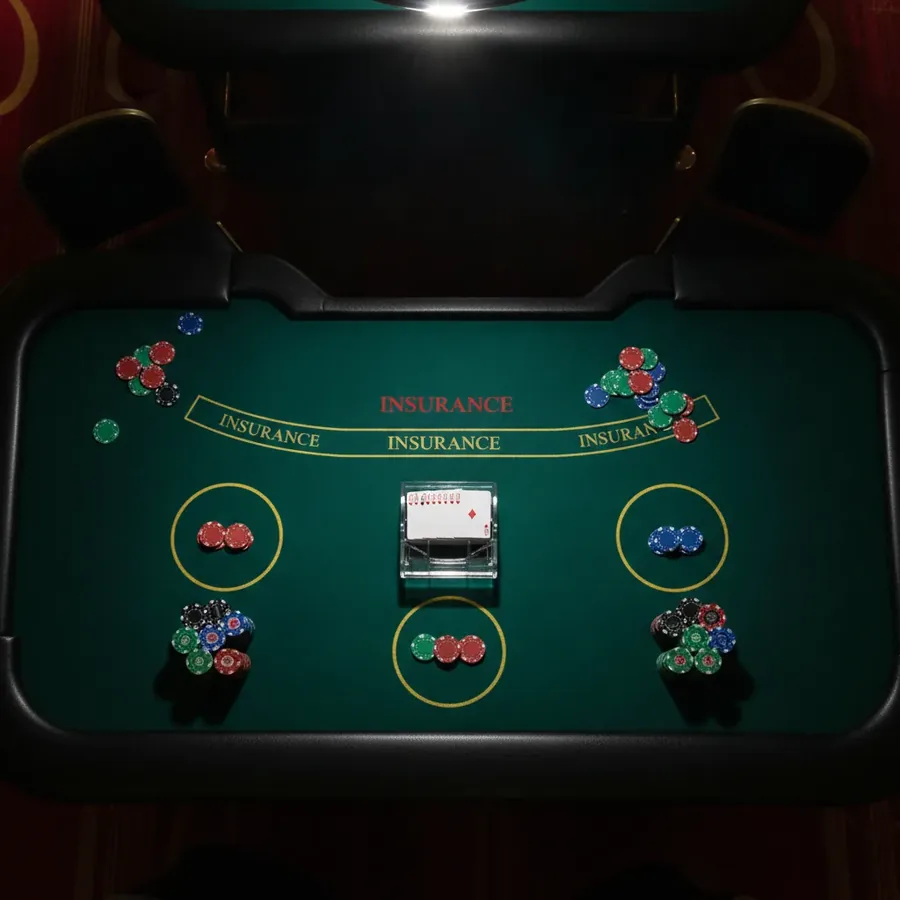
Blackjack Insurance is a side bet offered when the dealer's upcard is an Ace, allowing players to wager up to 50% of their main bet. This bet pays 2:1 if the dealer has a Blackjack. However, the RTP for this side bet is a considerably lower 92.53%, translating to a substantial house advantage of 7.47%.
Even Money is an option offered to a player who has achieved a Blackjack when the dealer's upcard is an Ace. Instead of waiting to see if the dealer has a Blackjack, the player can choose to take an immediate payout of 1:1 on their bet, forfeiting the potential 3:2 payout if the dealer does not have Blackjack. This is essentially a form of insurance on your own hand.
For a high roller, the decision between taking Insurance, Even Money, or declining both is a strategic one. While Insurance and Even Money offer a safeguard, they come at a cost, reducing the overall potential return. Basic strategy dictates always declining Insurance unless card counting indicates a significantly favourable true count of +3 or higher.
Shoe, Cut Card, and 75 Percent Penetration
In Blackjack, multiple decks of cards are shuffled together and placed in a shoe, from which the dealer draws cards. A cut card is inserted into the deck at a predetermined position, signalling the point at which the shoe will be reshuffled. This practice is standard across most live and online Blackjack games.
Penetration refers to how deep into the shoe the cards are dealt before reshuffling. A 75 percent penetration means that approximately three-quarters of the decks are played before the cut card is reached and the shoe is reshuffled. This depth of penetration can affect the house edge, particularly for players employing card-counting strategies.
For high rollers, understanding penetration is important. For instance, a game with 6 decks and 75 percent penetration means the shuffle occurs after approximately 4.5 decks have been dealt. Less penetration, meaning an earlier shuffle, generally favours the casino by reducing the effectiveness of card-counting techniques and slightly increasing the house edge compared to deeper penetration.
Blackjack variants at a glance
| Variant | Payout | House edge | Rule | Bet range |
|---|---|---|---|---|
| Blackjack 6 Decks, S17, DAS, DOA, Auszahlung 3:2, Basisstrategie | 99.54% | 0.46% | Dealer steht auf Soft 17; Verdopplung auf jeder Zweierkarte; Verdopplung nach Split erlaubt; keine Aufgabe. Basisstrategie ist für diesen Wert zwingend | Blackjack 3:2, normaler Gewinn 1:1, Insurance 2:1 |
| Blackjack Auszahlung 6:5 statt 3:2 (6 Decks) | 98.15% | 1.85% | Ersatz von 3:2 durch 6:5 fügt exakt +1.39 Prozentpunkte zum Vorteil des Casinos hinzu – stärker als jede andere Regeländerung. Bei $10 Einsatz zahlt Blackjack $12 statt $15. | Blackjack 6:5, Gewinn 1:1 |
| Blackjack Liberal Vegas Strip (liberale Regeln, 3:2) | 99.72% | 0.28% | Günstigste Regelkombination: S17 + DAS + Resplit + Late Surrender. Standardabweichung 1,15 | Blackjack 3:2, Gewinn 1:1 |
| Blackjack Ein Deck, klassische Regeln, 3:2 | 99.85% | 0.15% | Weniger Decks = niedrigerer Vorteil; ein Deck gibt ca. −0.48 Prozentpunkte gegenüber 8 Decks. Oft durch 6:5 Auszahlung kompensiert. | Blackjack 3:2, Gewinn 1:1 |
| Blackjack Split / Double / H17 – Regel-Effekte | n.a. (Regel-Modifikatoren) | H17 +0.22 Prozentpunkte; RSA −0.08 Prozentpunkte; DAS −0.14 Prozentpunkte | Dealer Hits Soft 17 verschlechtert RTP um 0.22 Prozentpunkte; Resplit Aces verbessert um 0.08 Prozentpunkte; Double After Split verbessert um ca. 0.14 Prozentpunkte; 6 Decks statt 8 – ca. 0.02 Prozentpunkte. | Double – Einsatz ×2 mit einer Karte; Split – bis 4 Hände; Ass-Split meist mit einer Karte. |
| Blackjack Surrender (Late Surrender) – Regel-Effekt | n.a. (Regel-Modifikator) | −0.08 Prozentpunkte | Spieler gibt Hand nach Dealer-Blackjack-Prüfung auf, verliert die Hälfte des Einsatzes. Verbessert RTP um ca. 0.08 Prozentpunkte. Early Surrender ist wesentlich wertvoller (bis −0.6 Prozentpunkte), aber extrem selten. | Rückzahlung 50% des Einsatzes |
Double Down vs Simple Hit on 11
Doubling down on a hand totaling 11 offers a strategic advantage, especially in games like Blackjack Split / Double / H17 where this option is available. This manoeuvre allows a player to double their initial bet in exchange for receiving only one more card. In the context of Blackjack 6 Decks, S17, DAS, DOA, Auszahlung 3:2, Basisstrategie, doubling on 11 is a fundamental play that can significantly improve outcomes over time.
The decision to double down on 11 versus taking a simple hit depends on the dealer's upcard, a core principle of basic strategy. For instance, in Blackjack Liberal Vegas Strip, which features a favourable RTP of 99.72%, doubling down on 11 against any dealer upcard from a 2 through to an Ace is generally advised. This play leverages the high probability of achieving a strong total of 19, 20, 21, or even 22.
When considering the choice, a simple hit on 11 against a dealer showing a 10 or an Ace could result in a bust or a lower total, whereas doubling down capitalises on the favourable odds. This strategic difference can translate to tangible financial benefits for high rollers, particularly when playing at tables with a low house edge, such as Blackjack Ein Deck, klassische Regeln, 3:2 with its 0.15% advantage.
Side Bets don't count towards bonus turnover
High rollers aiming to leverage welcome bonuses must be aware that side bets typically do not contribute to wagering requirements. For example, the four side bets available in Infinite Blackjack, which include Any Pair, 21+3, Hot 3, and Bust It, do not count towards the bonus turnover. This means any wagers placed on these additional betting options will not reduce the amount of bonus money that needs to be played through.
This exclusion is a critical factor for players who favour side bets, such as those found in Quantum Blackjack Plus Live, where multipliers can reach up to 1,000x. While these bets offer exciting potential payouts, their contribution to bonus wagering is zero. Players need to focus their play on the main blackjack hand to meet the bonus terms effectively. This is particularly relevant given the generous 300% welcome bonus up to €2,000 offered.
Consequently, a strategy focused solely on side bets, even with substantial stakes, will not fulfil the bonus conditions. For instance, a player betting €5,000 on side bets would still have the full turnover requirement outstanding. To clear the €2,000 bonus, which requires a 40x turnover, a total of €80,000 in qualifying bets must be placed, excluding all side wagers.
Live stream with three cameras and OCR
The live stream experience at Gransino, exemplified by games like Infinite Blackjack from Evolution, often employs advanced technology for an immersive feel. While not explicitly detailed for all games, a typical setup for high-stakes live blackjack would feature multiple camera angles, allowing players to follow the action from various perspectives. This visual richness enhances the perceived value of the live gaming environment.
The integration of Optical Character Recognition (OCR) is a standard in professional live casino operations, ensuring that game data, such as card values and player hands, is accurately translated into digital information. This technology is crucial for the seamless operation of side bets and for providing real-time updates to players. For instance, in Quantum Blackjack Plus Live by Playtech, OCR would ensure correct payout calculations for multiplied hands.
For high rollers, this technological sophistication translates into a more transparent and trustworthy gaming session. The ability to view the game from multiple angles, combined with the accuracy provided by OCR, minimises any potential for doubt regarding game integrity. This level of detail is essential when significant sums, such as the €5,000 maximum bet on Infinite Blackjack and Quantum Blackjack Plus Live, are involved.
Bonus Lost Due to 10 Percent Contribution
Players must be mindful of game contribution rates to avoid forfeiting their welcome bonus. Gransino assigns a 10% contribution rate to table games, including blackjack, towards the bonus wagering requirements. This means that only 10% of each bet placed on blackjack counts towards clearing the bonus, a significant factor for high rollers who typically wager larger amounts.
For example, a high roller placing a €1,000 bet on a blackjack table would only have €100 count towards the turnover requirement. To clear the €2,000 welcome bonus, which requires a 40x turnover (resulting in €80,000 in total wagers), a player would need to bet a substantial €800,000 on blackjack alone, assuming no other game types are played. This contrasts sharply with slots, which contribute 100%.
This low contribution rate for table games means that high rollers wishing to utilise the €2,000 bonus through blackjack play would need to place significantly larger bets or play a much higher volume of hands compared to players focusing on slots. The risk of losing the bonus due to insufficient turnover within the allowed timeframe is substantially higher when primarily playing blackjack at this 10% contribution rate.
Soft Hand and Hard Hand Practically Distinguished
Understanding the distinction between a soft hand and a hard hand is fundamental for any blackjack player, especially those employing strategic play. A soft hand contains an Ace that can be counted as either 1 or 11 without the total exceeding 21, offering flexibility. For example, an Ace and a 6 is a soft 17 (A+6=17).
Conversely, a hard hand is one where an Ace can only be counted as 1, or a hand that does not contain an Ace at all. For instance, a 10 and a 7 is a hard 17. In Blackjack 6 Decks, S17, DAS, DOA, Auszahlung 3:2, Basisstrategie, the dealer stands on soft 17, a rule that significantly impacts player decisions and optimal strategy.
The practical implication for high rollers is that knowing whether a hand is soft or hard dictates the correct playing decision, such as whether to hit, stand, double down, or split. This is crucial for maximising potential winnings and minimising losses, especially when playing at tables with favourable rules like Blackjack Liberal Vegas Strip (RTP 99.72%), where strategic accuracy is paramount.
Splitting costs double bet: plan budget
Splitting Aces in Blackjack, while often beneficial, requires doubling the initial bet. For instance, if a player holds two Aces with a 100 EUR stake and decides to split, the total bet immediately becomes 200 EUR. This strategy is crucial for managing finances when aiming for favourable outcomes, especially in games like Blackjack Liberal Vegas Strip with an RTP of 99.72%.
The Blackjack Liberal Vegas Strip variant offers a player-favourable RTP of 99.72%, but doubling your bet on a split can significantly increase exposure. If a player consistently splits Aces and doubles their bet on each resulting hand, a 100 EUR initial bet could escalate to 400 EUR or more within a single round. Therefore, a substantial bankroll is advisable for such aggressive play.
A player betting 1,000 EUR per hand would need to budget a minimum of 2,000 EUR to split Aces, assuming only one split per hand. This does not account for potential further splits or doubles after splitting (DAS), which are permitted in the Liberal Vegas Strip variant. High rollers must factor in these increased potential outlays to avoid compromising their overall gaming budget.
Bonus conditions often exclude Blackjack completely
The welcome bonus at Gransino offers 300% up to €2,000 plus 100 free spins. However, table games, including Blackjack, typically contribute only 10% towards bonus wagering requirements. This means that for every €100 wagered on Blackjack, only €10 counts towards clearing the bonus. This significantly extends the time and amount needed to fulfil the conditions for high-stakes Blackjack players.
A player aiming to clear a substantial bonus, for example, a €2,000 bonus with a 40x wagering requirement (€80,000 total turnover), would find Blackjack's 10% contribution a major obstacle. Wagering €80,000 on Blackjack alone would necessitate a total bet of €800,000. This makes it impractical for high rollers to primarily use Blackjack to clear such a bonus.
Many online casinos, including potentially Gransino given the 10% contribution, may even exclude Blackjack entirely from bonus wagering. If Blackjack is completely excluded, as is common, high rollers seeking to leverage bonuses would need to focus on other game types like slots, which contribute 100% to wagering. This effectively negates Blackjack as a bonus-clearing strategy.
How long does a Live Blackjack round take?
Live Blackjack rounds can vary in duration, but a typical hand involving a decision from each player, including those at Infinite Blackjack, can take between 15 to 30 seconds. This speed is maintained to accommodate the unlimited number of seats and keep the game flowing smoothly for all participants. Bet limits on Infinite Blackjack range from 1 EUR to 5,000 EUR, accommodating various player stakes.
In Blackjack Party, the pace might be slightly slower due to the entertainment focus with two hosts, though actual gameplay decisions are similar. Even with quick decisions, high rollers betting the maximum of 5,000 EUR per hand on Infinite Blackjack or Quantum Blackjack Plus Live will see their capital turnover rapidly. A 30-second round with a 5,000 EUR bet represents a €10,000 per minute turnover rate.
Quantum Blackjack Plus Live, with its RTP of 99.57%, offers potential multipliers up to 1,000x on three-card 21s, adding a layer of excitement. While the base game action is swift, the inclusion of side bets and the general flow of dealing and player decisions mean a full round, including betting time, can extend to around 45-60 seconds. For a player betting 5,000 EUR, this still represents a significant amount of capital in play per minute.
Surrender vs Playing Out on 16 vs 10
Choosing to surrender a hand of 16 against a dealer's 10 is a key strategic decision in Blackjack, especially concerning house edge. While specific RTP for surrender isn't provided in all variants, it's known that Late Surrender can reduce the house advantage by approximately 0.08 percentage points. This means losing only half your bet instead of potentially losing the entire stake.
In a scenario where a player holds a hard 16 against a dealer's upcard of 10, playing out the hand statistically leads to a higher loss than surrendering. For a high roller betting 1,000 EUR, playing out a losing hand could mean a full €1,000 loss. Surrendering, however, limits the loss to 50% of the bet, which is €500 in this example.
The Blackjack Liberal Vegas Strip, with its low 0.28% house edge, still benefits from strategic plays like surrender. If this option were available and strategically applied when holding 16 against a 10, it would further improve the player's theoretical return. However, the 'Blackjack 6:5 statt 3:2' variant, with its 1.85% house advantage, makes the decision to surrender even more critical to mitigate losses.
Perfect Pairs vs 21+3 in House Edge
Side bets like Perfect Pairs and 21+3 offer additional ways to wager in Blackjack, but they come with a significantly higher house edge than the main game. Perfect Pairs pays out on specific pairs, while 21+3 combines the player's first two cards with the dealer's upcard to form poker hands. These bets are separate from the base game's RTP.
The RTP for side bets is not explicitly detailed for all variants, but they are generally understood to be less favourable. For example, if a player wagers 100 EUR on a side bet with a 7.47% house edge, as seen with Blackjack Insurance, the expected average loss is 7.47 EUR per bet. This is substantially higher than the 0.46% house edge of a standard Blackjack 6 Decks, S17, DAS, DOA game.
High rollers might be attracted to the potential for large payouts from side bets like 21+3, which can offer payouts up to 100:1 for certain combinations. However, the increased house edge means that for every 1,000 EUR wagered on these side bets, the casino expects to retain considerably more than on the main Blackjack game. This makes them a less optimal choice for long-term play.
Contact
Live - online chat
Banking









Providers












Gransino Casino 2026